
Survey the current state
Measure the room, count the filing inches, record the equipment and photograph how files are actually stored today.
A plan to get you out front: analyse current practice, assess on-going needs and produce a comprehensive Document Management Plan.
Most organisations do not have a records problem because they lack shelving. They have one because nobody has decided what to keep, how to label it, or where it should live. Our process answers those questions in order, then delivers the physical result.
The goal is to increase efficiency while creating a productive, comfortable work environment — keeping staff productivity at a maximum by keeping research and retrieval to a minimum.
Measure the room, count the filing inches, record the equipment and photograph how files are actually stored today.
Watch how files move: who pulls them, how often, and where the bottlenecks form. A file room that is slow is usually a workflow problem before it is a space problem.
Establish growth rate. A system sized for today will be full in three years; a system sized for the retention period will not.
Decide what must be kept, for how long, and under which regulation. Everything else is a candidate for destruction.
Create a labeling and index structure staff can apply consistently — alphabetic, numeric, terminal digit or a hybrid.
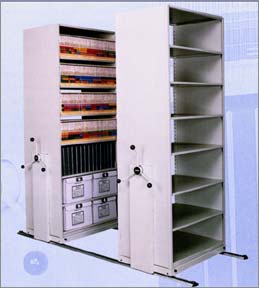
Model static and mobile options in CAD and quantify capacity, aisle clearance and circulation for each.
Shelving, carriages, cabinets, safes and shredders matched to the volumes and sensitivities identified earlier.
Sequence the work so daily operations continue: by range, by year, or at the point of a physical move.
Factory-trained, certified personnel install the system, convert the files and verify sequence.
Train staff on the new scheme and measure retrieval time afterwards so the improvement is demonstrable.
Define how long each record class must be kept — and destroy the rest with confidence.
Follow a document from creation through active use, archive, storage and scheduled destruction.
Align filing practice with HIPAA and other record-keeping obligations, including evidence and public records.
Build a scheme staff apply consistently, so a file returns to the same place every time.
Metadata that makes a record findable on paper or on screen, and links physical folders to FileTracker or your own system.
Measure retrieval times and misfile rates so the system keeps improving after hand-over.
Before anything is ordered, we measure. Accurate drawings let us show you exactly how many filing inches you gain, where the aisles fall and how the room will be circulated — so the investment is justified before it is made.
Typical outcomes of a well-planned conversion:
Toll free 800-396-0738
Local 252-355-6948
Fax 252-355-6953
sales@systems-sales.com
Ask for Bill Lehman for product and project enquiries.
2780 Dickinson Avenue
Greenville, NC 27834
Directions & contact form
Talk to a records management consultant about your filing, storage and compliance requirements. No obligation, no pressure.